
The Daedalus Seven is a massive generation ship that I originally designed for Episode #34 (“World-Building: Generation Ship”) of the Hourlings Podcast Project.
In short, this is a world-building project for a spaceship large enough to warrant a serious world-building effort. Part 1 discussed the general setting, the generation ship itself. Part 2 detailed the situation in which the Daedalus Seven found itself after an extraordinarily long voyage. Specific settings which required significant world building were detailed. Namely, the six large habitat cylinders and the central crew spindle, all largely disconnected from each other for much of the ship’s multi-millennium voyage.
In Part 3 (this entry), we’ll be looking at world building for Cylinder 6, a spinning habitat that is 100 km long, with a radius of ten km. This is also somewhat strategic, as I’m in the planning stages for a novelette set in this habitat.
If you have not read Part 1 (or viewed the podcast), then please read that part before continuing. Part 2 is also required background, as it provides more information about the habitats of the Daedalus Seven.
Habitat Geography
Cylinder 6 is known by its inhabitants as Sakoy. After twelve thousand years in space, the ancient loss of access to Daedalus‘ computer systems, and the historical breakdown of most high-tech artifacts, the majority of inhabitants are unaware that their world’s name was derived from the word sequoia, and are largely clueless that the world is an artificial creation. The habitat was originally designed to preserve the giant sequoias and several related species of trees, as well as the complete ecosystem of a temperate rainforest (which is what the sequoias actually represent in the current-day Pacific Northwest).
At this time, Sakoy is divided into two primary areas, separated by an irregular ring-like “sea” called the Gerd. About 40% of the habitat’s surface area is located south of the Gerd, with 50% to the north. The sea itself occupies about 10% of the surface area. By convention, south is the downward end of the cylinder, toward which there is a slight drift due to the ship’s continued slight acceleration (south is shown as the left side of the map).
The map dimensions are 100 km by 63 km, or roughly the size of the state of Delaware.
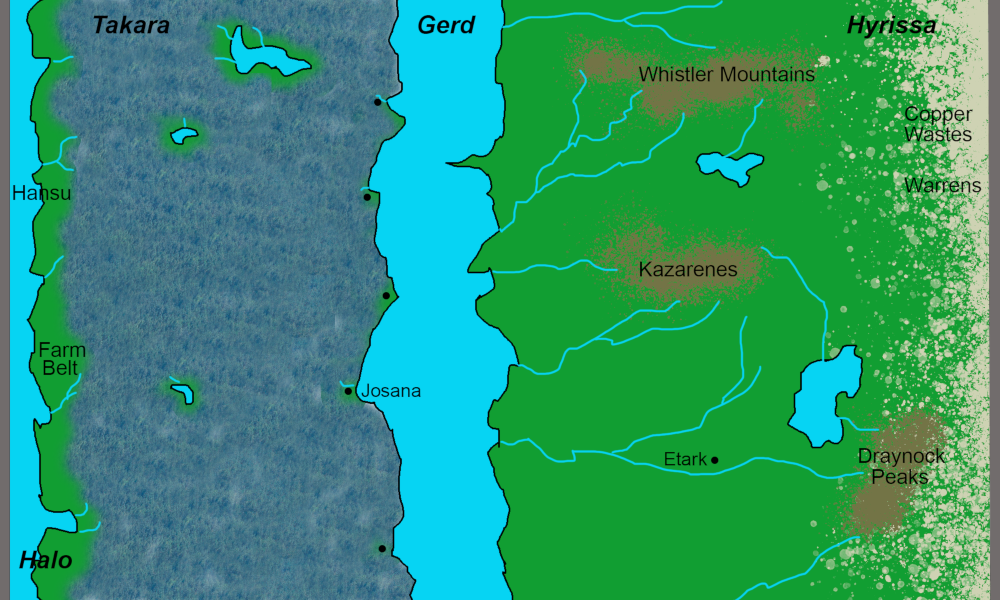
The southern land area is known as Takara. The landscape is hilly and almost entirely covered (about 85% of the land area) with giant redwood trees. Most of the area is maintained in a wild state, which includes heavy undergrowth and numerous native animal species. A ring lake known as the Halo occupies the south side of Takara. Its northern shore is known as the Farm Belt, and is dedicated to agriculture.
The northern land area is known as Hyrissa. It has no redwoods left and is almost entirely covered by farms, towns and cities. It is heavily overpopulated and controlled by an increasingly aggressive theocracy.
Each habitat base contains a warren of rooms, corridors, and other living spaces, About half of Takara’s population resides in the urban confines of the base. By contrast, the northern habitat base, known locally as the Warrens, is largely uninhabitable, having been demolished over centuries due to an anti-tech religious bias common to the Hyrissa population.
Note that Cylinder 6 is paired with Cylinder 3. They are directly opposite from each other in the circular arrangement of the ship’s six habitat cylinders and rotating in opposite directions for stability reasons. They are the only pair where both habitats are undamaged, so they aren’t subject to the minor or major “quakes” that some of the other habitats experience. However, because there are stability issues with the entire habitat formation, Sakoy does sometimes suffer from temblors, very mild quakes.
Cultures
Sakoy supports two major cultures and three smaller ones:
- Takara: An Asian-like culture that is largely pacifistic, embodies a distinct system of honor, and has a somewhat higher tech level than the Hyrissa. (11% of Sakoy’s population)
- Hyrissa: An authoritarian theocracy that promotes continued growth and expansion, organizes society into distinct castes, and is rabidly anti-technological (particularly against ancient high technology). (88% of Sakoy’s population)
- Bajaw: A nomadic people who live aboard houseboats on the Gerd. They are sometimes referred to as the “boat people.” They are sailors, fishermen, and pearl hunters who regularly trade with both Takara and Hyrissa. Some of them also reside on the Halo. (1% of Sakoy’s population)
- Skavs: Secretive inhabitants of the Warrens. (< 1% of Sakoy’s population)
- Domba: A tribal culture of musicians, dancers, artists, and small-time traders that permeates the other cultures. (< 1% of Sakoy’s population, and considerably fewer than the Skavs).
Next Steps
This entry has provided an overview of the geography and cultures of Sakoy, Habitat 6 of the Daedalus Seven. However, world building includes more than just the technical aspects of a world. In Part 4, we’ll do a deep dive into the government, culture, and religion of Takara. Part 5 will focus on the Hyrissa (who doesn’t want to design a hostile, antagonistic theocracy to be the bad guys?). Part 6 will focus on the smaller cultures, the Bajaw, Skavs, and Domba.
Leave a Reply