

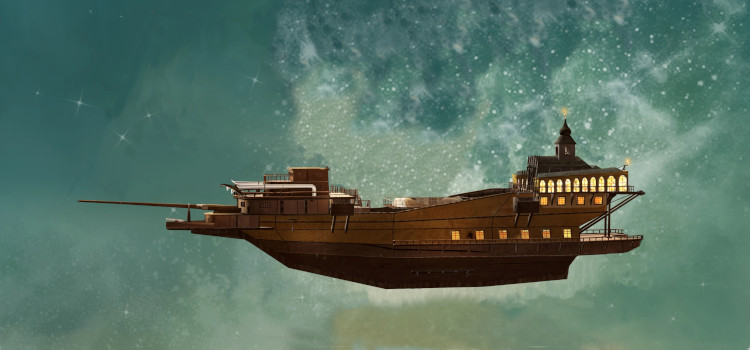
It’s the 1840’s in a steampunk fantasy world where magic exists alongside science and the Fey have rubbed shoulders with humanity for centuries. Europe has been ruled by a triumphant Empire of France…at least until the Elvish Dominion decides to “Do Something” about humanity. The Dominion goes to war with the major nations of the world, helped by their Fey allies and the magically bred soldiers, the Orakai (nicknamed orcs by humanity), that they’ve created and enslaved to fight for them.
Magically powered airship fleets clash in the sky as battle rages across the world. Welcome to The Long War.
Still, even airships held aloft by magical lift panels (and not balloons) have constraints on weight and size that seagoing vessels do not possess. These factors also affect both the durability of aerial vessels and the amount of weaponry that they can carry.
Here are the primary categories of military airships participating in this world-spanning war:
Coppice-Class: A huge class of airship, solely produced by the Elven Dominion. The term is derogatory; a “coppice” is a tree that has been trimmed of its branches, which is then burned in order to make charcoal. The nomenclature signifies that such a large, heavily armed, and ponderously slow vessel is ”good for nothing but making charcoal bricks.”
Coppice-class vessels are the largest and most powerful airships, carrying a 100 or more guns on three or more decks. While they are rare, the Dominion managed to field an unprecedented eight of them at the Battle of the Marne Valley in 1841.
Some Coppice-class vessels are known to be equipped with the “lightning lance,” a new, front-mounted arcane weapon that shoots a sizzling beam of fire and is effective at extreme ranges (subject to limitations in accurate aiming).
Battleships: Also known as ships of the stack, or “stackers,” after the formation where ships stack vertically to mutually protect the vulnerable undersides where their lift panels are exposed.
These are large and heavily armed airships designed primarily for engaging in ship-to-ship combat. Battleships are equipped with powerful cannons and serve as the backbone of aerial fleets. They carry between 30 to 64 guns on two decks and are generally used in major fleet actions. They are categorized as follows:
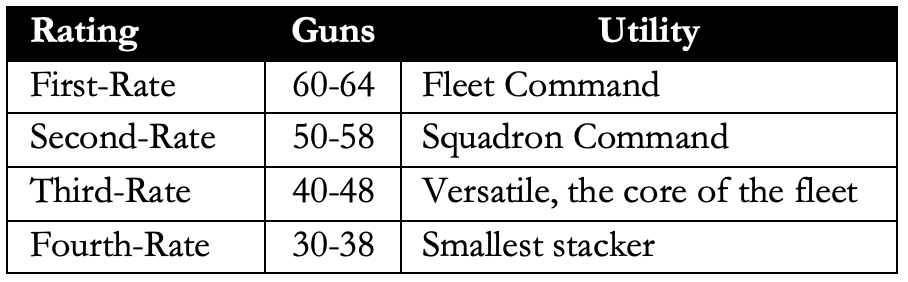
At 36 guns, Shapiro (featured in the novella Pivot Point) is an older fourth-rate, but faster and more nimble than most airships in that category thanks to her rare, and thus unusually light, ironwood structure. Although still officially classified as stackers, fourth-rates are seldom used in stacks anymore in the 1840s.
- Frigates: Frigates are medium-sized airships that are highly versatile, typically armed with 16 to 28 guns. They are primarily used for escorting merchant ships, engaging in reconnaissance missions, and conducting patrols. Frigates are known for their speed and maneuverability and often carry a mix of weaponry, including cannons as wells as smaller guns.

The Portuguese privateer Vingador (featured in the novella Storm Chaser and the online vignette A Notable Account) represents an unusual case. At 14 cannons in its original configuration, it was a sloop, a sixth-rate airship. With the addition of two cannons, one fore and aft, as well as additional lift panels from captured prizes, it was essentially upgraded to a small frigate.
Sloop: Sloops are smaller vessels compared to battleships and frigates, but are still an important part of naval forces. These ships are typically used for common tasks such as coastal defense, anti-piracy operations, and patrolling trade routes. In fleet battles, they may also be used as message boats. Sloops are typically armed with 8 to 14 cannons and have a crew size that permit effective operations over long periods of time with little resupply.

Steam Frigates: A new class of ship, featuring a steam-powered propeller system. The fastest and most maneuverable of all ships, as long as their coal supplies last. Typically armed with 10 – 16 guns. In the 1840s, they are rare enough that they have yet to be integrated into fleet operations in any meaningful way.
Steam Packets: Small, unarmed steam-powered airships used for high speed reconnaissance and as message couriers.
Updated to reflect the evolution in the world building that underpins this series of stories. The first is “Pivot Point,” a novella that will be released soon. The second is a novelette (or possibly novella) entitled “Storm Chaser.”
Many thanks to Bill Aguiar, the infamous Tropemaster, for his feedback on the world building and the era of 19th century fleet battles. Any mistakes are mine, but I assure you there are a lot few of them now than there were.